
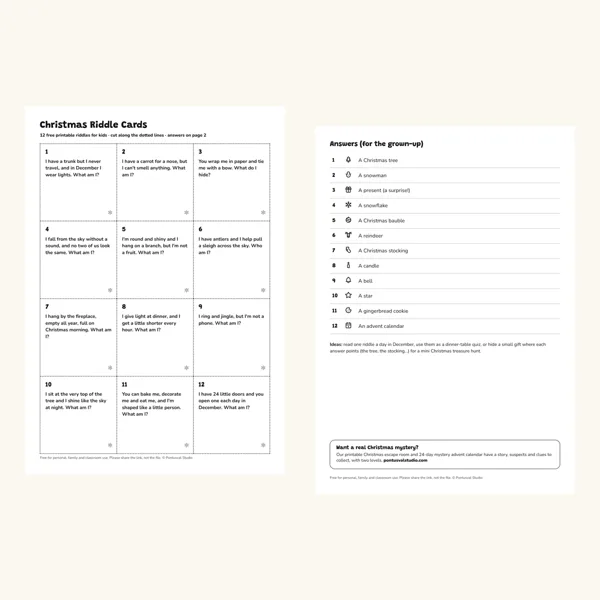
Christmas riddles for kids: 46 riddles with answers (+ free printable cards)
46 original Christmas riddles for kids with answers: easy, tricky, funny, math and winter riddles, plus 12 free printable riddle cards (PDF) and a hunt idea.
· 11 min read
Launch sale: −25% on Etsy until 20 NovemberCyber Specials: −30% on Etsy until 1 DecemberInstant download · Print at home · 2 levels in every game
[email protected]40 easy rainy day activities for kids: quick screen-free ideas, active indoor games, crafts, puzzles and a simple afternoon plan, sorted by age from 3 to 12.
Rain against the window, children bouncing off the sofa, and a long afternoon ahead. Most parents know the feeling. The good news is that a rainy day does not need a big budget or a clever plan: it needs a handful of ideas you can pull out at the right moment, and a little rhythm between noisy games and quiet ones.
This list gathers 40 indoor activities for kids that work with what you already have at home. They are grouped by type, so you can pick a quick filler, a game to burn off energy, a craft, or something calm for the end of the day. Further down you will find suggestions by age and a simple plan for a whole rainy afternoon.
These are the ideas to keep in your back pocket for the moments between two bigger activities, or when you need five minutes to finish a phone call.
1. Sock basketball. Roll socks into balls and aim for a laundry basket. Move the basket one step back after every successful shot to keep it interesting.
2. “I spy” with a twist. Instead of colours, use shapes, textures or first letters: “I spy something soft”, “something that starts with B”. It works for every age if you adapt the clue.
3. Window race. If the rain runs down the glass, each child picks a drop and cheers it on. It sounds silly, and that is exactly why children love it.
4. Draw it blind. One child describes a simple object; the other draws it without knowing what it is. Compare the drawing with the real thing at the end.
5. Tidy-up countdown. Set a timer for three minutes and see how many toys go back in their box. Turn it into a game against the clock and the house looks better too.
6. Story in three words. Each person says three words, and together you build a story. Write it down: younger children love hearing their own story read back.
7. Freeze dance. Put on music, dance, and freeze when it stops. Whoever moves sits out for one round, then comes back in, so nobody is out for long.
When children have been indoors for a few hours, they need to move. Clear a space, put fragile things out of reach, and choose games that do not need running at full speed.
8. Living-room obstacle course. Cushions to jump over, a chair to crawl under, a line of tape to walk along. Let the children design the next course themselves.
9. Balloon keep-up. The balloon must not touch the floor. Add rules as they get better: only elbows, only heads, or count the touches together as a team.
10. Animal moves. Call out an animal and everyone moves like it: bear walk, frog jumps, crab walk, flamingo balance. It is a great way to use up energy in a small space.
11. Hallway bowling. Use plastic bottles with a little water inside as pins and a soft ball. Keep score on a sheet of paper so younger children practise counting.
12. Simon says, house edition. “Simon says touch something wooden”, “Simon says find something blue”. Children run to a spot and back, which keeps the game moving.
13. Paper-plate skating. On carpet, children stand on two paper plates and slide around like skaters. On hard floors, use thick socks instead and keep an adult close.
14. Treasure hunt. Hide a small object and give clues: “warmer” when they get close, “colder” when they move away. For something more structured, try our free printable indoor scavenger hunt.
You do not need a craft cupboard. Look in the recycling bin, the kitchen drawers and the stationery box first. Put down an old sheet or newspaper and the clean-up becomes much easier.
15. Cardboard box world. A large box becomes a car, a rocket, a shop or a castle. Give children markers and let them decide what it is.
16. Paper-roll figures. Toilet-paper rolls turn into animals, people or tiny robots with a few strips of paper and some glue.
17. Rain pictures. Draw a picture with washable markers, then hold it out of the window for a few seconds. The rain blends the colours into something new.
18. Paper boats. Fold simple paper boats and test them in a bath or a large bowl of water. Which design floats longest?
19. Collage from old magazines or flyers. Cut out pictures and words to make a poster: “my perfect day”, “my dream house”, “things that make me laugh”.
20. Salt dough. Flour, salt and water make a dough that children can shape into figures. Let them dry and paint them on another day, which gives you a second activity for free.
21. Make a comic strip. Fold a sheet into four boxes and tell a short story in four drawings. Speech bubbles are optional for children who are not reading yet.
Puzzles are a good way to calm the energy down while keeping minds busy. Choose a level just above what the child finds easy: a little challenge is fun, too much is discouraging.
22. Homemade jigsaw. Draw a picture on card, then cut it into pieces. The more pieces, the harder the puzzle.
23. Memory game. Draw matching pairs on small squares of paper, shuffle them face down, and play. Children can make the cards themselves first.
24. Spot the difference. One child arranges ten objects on a tray; the other looks, turns away, and finds what has moved or disappeared.
25. Secret codes. Write a message where every letter is replaced by a number (A=1, B=2…). Children decode it, then write a coded message for you.
26. Word chain. Each word must start with the last letter of the previous one. For younger players, use the first sound instead of the letter.
27. Building challenge. With blocks, cups or books, who can build the tallest tower that stands for ten seconds? Add limits like “only twenty pieces” to make children think.
Pretend play is where a rainy day can turn into an adventure. Give the children a role and a goal, and the house becomes a ship, a laboratory or a detective agency.
28. Shop or restaurant. A menu written on paper, toys as products, a few coins. Children take turns being the customer and the shopkeeper.
29. Fort building. Chairs, blankets and pegs make a hideout. Bring in a torch and a few books, and the fort becomes a reading den for later.
30. Detective game. Hide a toy and leave a trail of simple clues: a footprint drawn on paper, a riddle, a note with an arrow. Children love being the ones who solve the case.
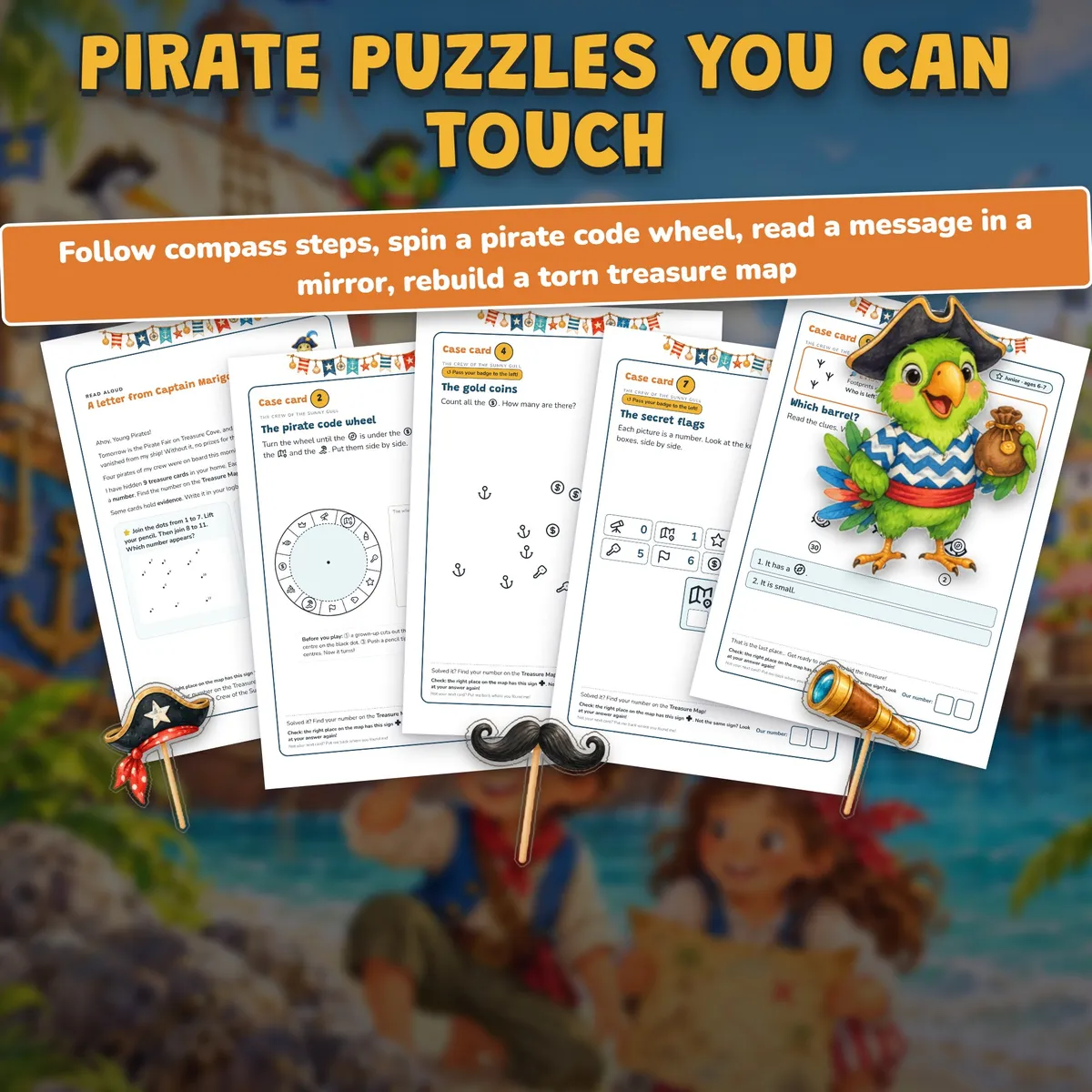
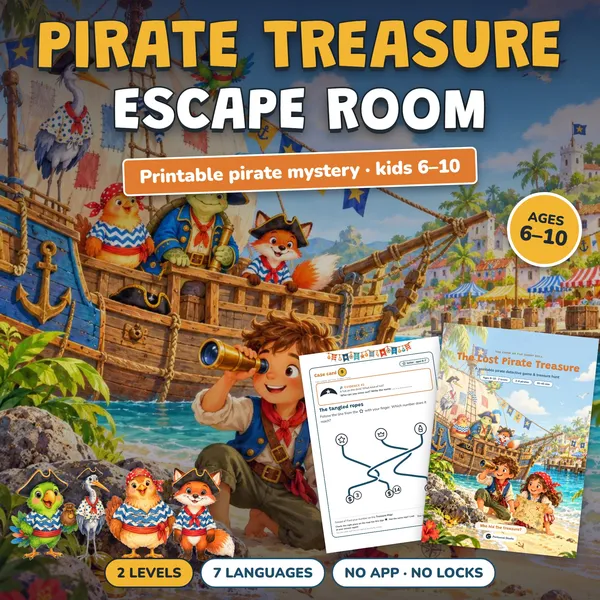
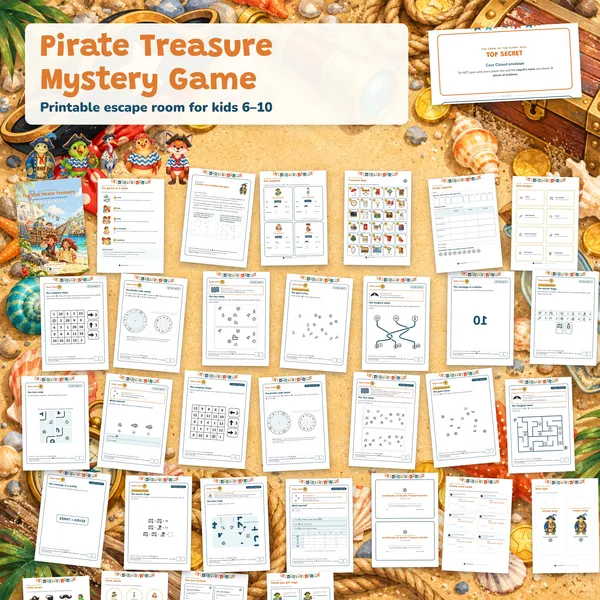
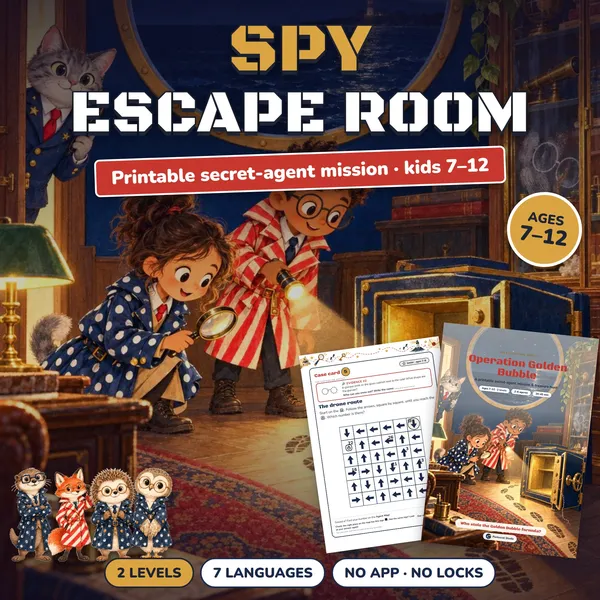
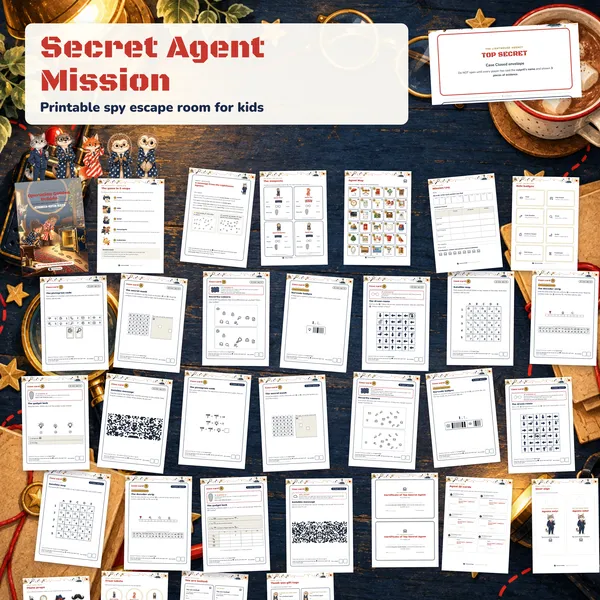
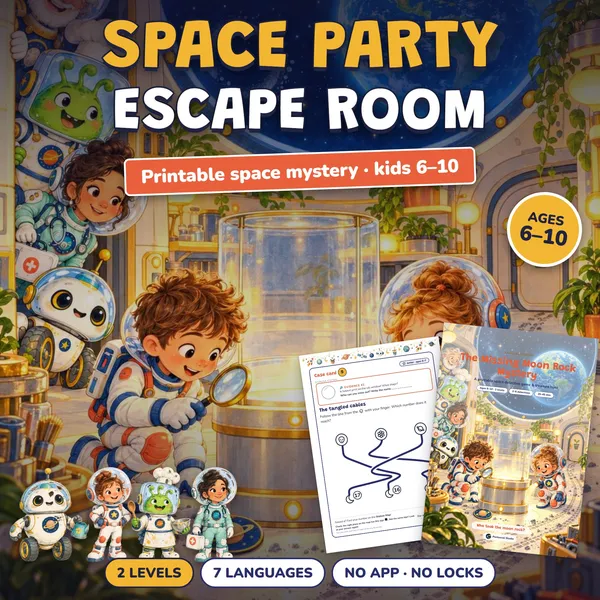
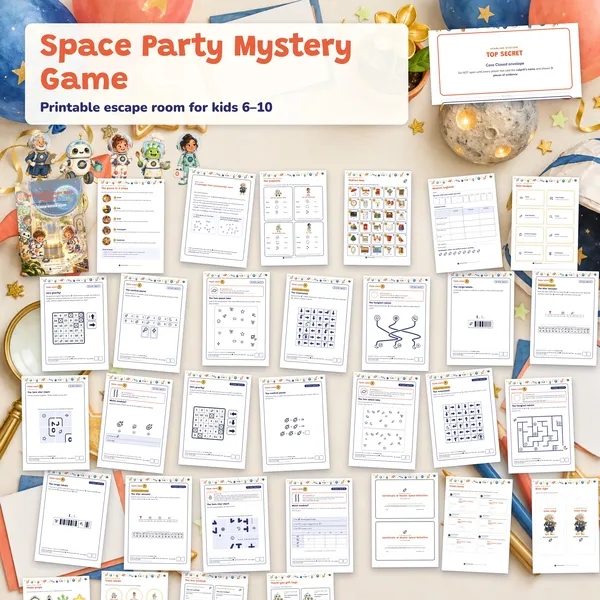
31. A printable mystery game or escape room. This is the long-format option for a really wet afternoon. In a printable escape room, you print the pages, hide the cards around the home, and children solve one puzzle after another to find the next clue and crack the mystery. Our pirate treasure hunt and spy escape room work this way: there is no app and no padlock to buy, black and white printing is fine, and each game comes in two levels, Junior and Expert, so children of different ages can play the same story together. Play time is about 30 to 45 minutes by our estimate, plus setup. You can see every theme on the all games page, and our guide on how to run a printable escape room at home walks you through the setup.
32. Puppet show. Socks, paper bags or wooden spoons make puppets. A table turned on its side, or a sheet over a chair, makes the stage.
33. Explorers indoors. Give each child a notebook, a pencil and a mission: “find five things that are round”, “draw three things that make a noise”. It is the spirit of a field trip, without the rain.
The end of a rainy day is the time for quieter activities. Dim the lights a little, lower the volume and offer one of these.
34. Read and retell. Read a book together, then ask the child to retell it to a toy. Retelling a story is harder than it sounds, and it slows everyone down.
35. Colouring and drawing. Put out paper and pencils without any instructions. Children often settle into it on their own.
36. Sorting jobs. Sort buttons, beads, socks or crayons by colour, size or shape. It is calming, and for younger children it is real learning.
37. Stretching time. A few slow stretches, counting to five each time, or lying on the floor and “melting” like ice cream. It helps the body calm down after a busy day.
38. Gratitude list. Each person names three good things from the day. On a grey day, it is a nice way to notice what went well.
39. Listening game. Close your eyes for one minute and listen. Then each person says what they heard: rain, a car, the fridge, a bird.
40. Plan the next rainy day. Ask the children which activities they liked best and write them on a list on the fridge. Next time it rains, they choose from it.
Every child is different, so treat these as starting points rather than rules.
At this age, short activities work best, and an adult nearby makes everything more fun. Good picks are freeze dance, animal moves, balloon keep-up, sorting jobs, salt dough and simple pretend play like a shop or a picnic. Keep scissors and small objects for when you are sitting right next to them, and expect to switch activity every 15 minutes or so.
Children of this age love rules, challenges and stories. Try the obstacle course, secret codes, the detective game, comic strips and building challenges. They can also start a printable mystery game with a little help: a Junior level with picture puzzles and very little reading is a good fit for early readers.
Older children want real challenges and some responsibility. Let them design an obstacle course or a treasure hunt for younger siblings, write a longer comic, run a puppet show, or tackle an Expert level of an escape room with more steps and some maths. Giving them the role of “game master” for the little ones is often the activity they enjoy most.
You do not need to fill every minute. A rough rhythm that alternates moving and sitting is usually enough. Here is one way to plan three or four hours:
Two small tips make a big difference. First, prepare a “rainy day box” in advance with paper, tape, markers, a few printed games and a list of ideas, so you are not searching when you need it. Second, let children choose between two options rather than asking “what do you want to do?”: the choice is easier and the day runs more smoothly. If you want more ideas around the same theme, our rainy day activities page groups our games that work best for an afternoon at home.
Plenty: active games like an obstacle course or balloon keep-up, crafts with cardboard and paper, puzzles and secret codes, pretend play, and calm activities like reading or colouring. The key is to alternate moving and sitting, and to have a few ideas ready before the rain starts.
Choose activities where each child can play at their own level. Older children can build the obstacle course or hide the clues while younger ones play. Games with two difficulty levels also help: in our printable escape rooms, each child can solve their own version of the same card, so everyone follows the same story.
Animal moves, freeze dance, balloon keep-up, hallway bowling and a living-room obstacle course all get children moving in a small space. Clear the area first, move anything fragile, and keep running games for a hallway rather than a room full of furniture.
It depends on the age. Children aged 3 to 5 often switch after 10 to 15 minutes, while children aged 8 to 12 can stay focused on a good game for 45 minutes or more. Plan one longer activity for the middle of the afternoon and shorter ones around it.
Shop
 −25%−30%
 −25%−30%
 −25%−30%
 −25%−30%
Blog
46 original Christmas riddles for kids with answers: easy, tricky, funny, math and winter riddles, plus 12 free printable riddle cards (PDF) and a hunt idea.
· 11 min read
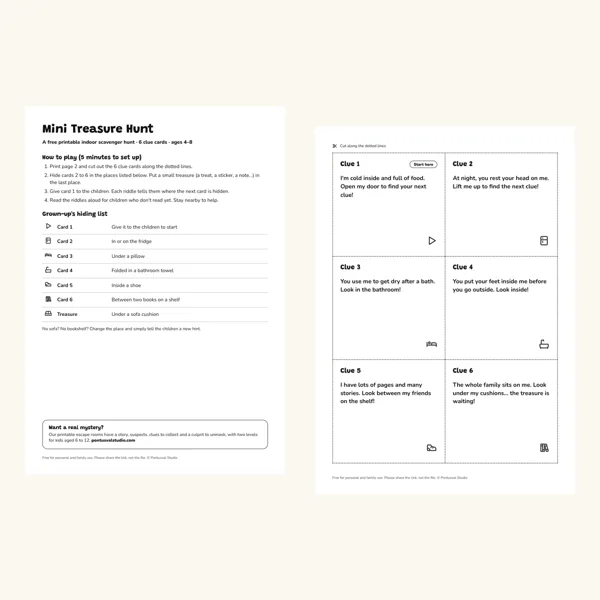
A free printable treasure hunt for kids aged 4 to 8: 6 riddle clue cards to hide around the house, a hiding list for grown-ups, A4 and US Letter PDF.
· 3 min read
Choose the right game, print it, hide the clues and run the game calmly: a practical step-by-step guide for parents, from setup to the final reveal.
· 6 min read